What a sample can’t tell you before a bulk cardboard cat house order
A sample comes back looking right, everyone nods, and then someone has to sign for a bulk run. The unit does not change between those two moments — the route does. Any cardboard cat house factory quotes one of three ways: OEM built to your drawing, ODM from a mold already on the floor, or a stock program with a pack change. Price, minimum, and lead time all move with that choice, and the quote usually names none of it.
So the first question is not about quality. It is which route the supplier assumed. A quote that looks sharp on one sample can be a stock program with your artwork dropped in, while the buyer is picturing a custom build. Get the route named before the sample is signed off, and get the minimum quoted on that basis rather than on the sample.
What the sample never shows is the packing half: carton cube, where the barcode lands on a folded pack, how many units fit a master carton. Material adds a second gap. A 10 cm scratch pad stacks roughly twice the corrugated sheets of a 5 cm pad, so weight, cost, and container fill shift long before anything is printed. Ask every supplier for those same figures, then compare. Petaful publishes its sample and production clocks alongside its model range, which at least gives you a fixed point to hold other quotes against.
Container scale is where the loose ends get expensive. The packing spec needs signing before bulk, not after. Units per carton need confirming in writing. And one unit needs pulling off the line and checking against the approved sample, because the one in the meeting room was not built at line speed.
Then decide who in the room owns what. Procurement owns landed cost per unit, product design owns flute direction and scratch life, and whoever owns the channel owns shelf or FBA readiness. Before anyone approves, get one sentence on paper: the route, the MOQ basis, and the pack format the quote is built on.
OEM, ODM, or stock: which cardboard cat house factory route fits your channel
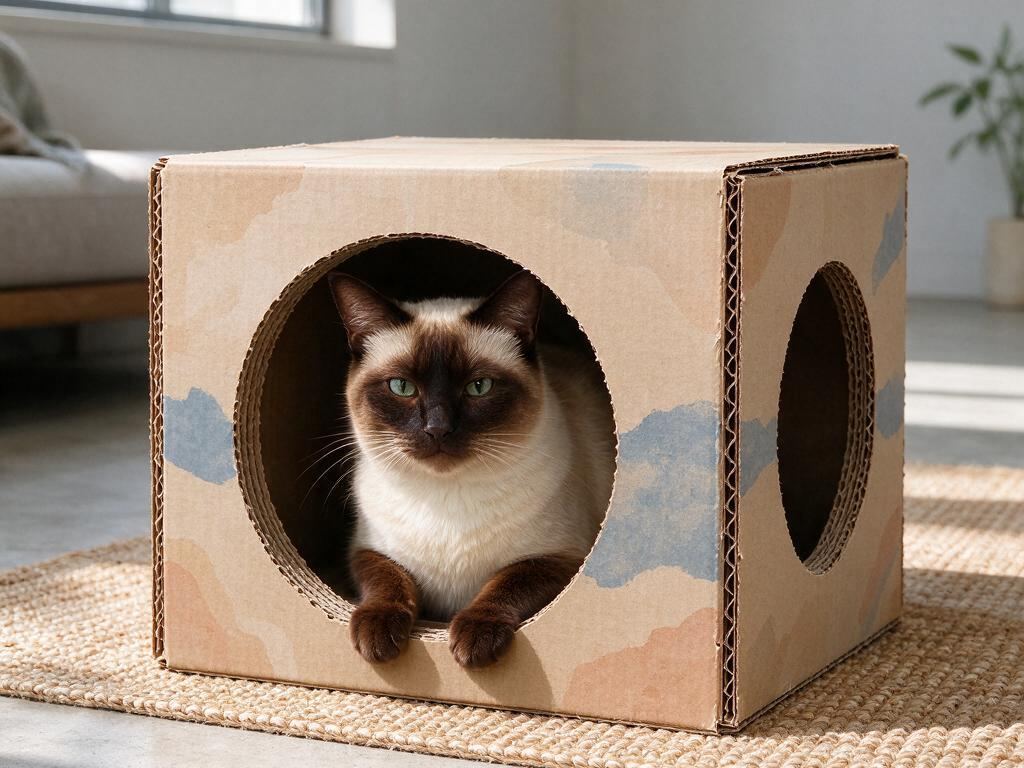
A cat peeks from a hide-and-seek cardboard cat house with crisp die-cut openings.
The three routes on a cardboard cat house factory quote differ less on unit price than on when the clock starts and who eats the cost of a plate or a die. Below is what each one asks of a buyer.
| Route | MOQ basis | Tooling, and who pays | Lead time from art approval | Pack and print flexibility | Risk it carries |
|---|---|---|---|---|---|
| Stock program, pack change | Stock minimum, confirmed per order — the lowest entry quantity | None, unless you add a printed box and its plates | Artwork plus press time on the existing line | Poly bag or kraft sleeve standard; a printed color box usually lifts the minimum | Anyone can buy the same shape, so differentiation falls to brand and print |
| OEM to your specification | Specification minimum, set by structure, flute, and run length; quoted per order | Print plates and a new cutting die, charged to you | Sample round first, then bulk after art approval; no mold work ahead of the line | Widest: dieline, flute direction, print coverage, FBA-ready pack | The dieline is yours — a wrong dimension or barcode position is your cost |
| ODM from an existing mold | Tooling-triggered, often the highest of the three | Lower, since the mold exists; plates and decoration still apply | Longest: mold scheduling sits ahead of your run | Shape is fixed; decoration and pack are not | A mold change moves schedule and price together, and both land on you |
ODM removes the design work and hands back the longest production clock. A stock program buys a small entry quantity and gives up shelf differentiation. OEM usually finishes sooner than ODM because nothing sits in front of the line — that advantage evaporates when a complex build or a late dieline revision puts days back into the schedule, so ask what sits between artwork approval and the first carton off the line.
MOQ is where these choices land. Catalog figures go stale; suppliers in this category confirm the minimum per order against your exact structure and pack. Get MOQ basis, tooling charge, sample clock, and carton dimensions onto one page, and compare rows only after the quotes are built on the same pack format — a poly-bag quote and a printed-color-box quote are not the same number, and the gap is packing, not cardboard.
First run, restock, or container load: what each order size actually buys
Order size is not a discount ladder. Each step up changes what the order is actually testing, and the question worth putting to the factory changes with it.
A first run of a few hundred units buys information. The house goes in front of real cats and real shelves: does the corrugated surface hold up to a cat that scratches at it daily, does the price point survive sitting next to the brand beside it, will anyone pick it up. What that volume cannot buy is print economics or a structure that does not exist yet. Plates and dies cost about the same whether they spread across a few hundred units or several thousand, so at first-run scale they land hard on every piece. Ask which parts of the specification already sit on the factory’s floor, and what the smallest run is at which they would cut a new die for the rest. E-flute at about 1.5 mm is the common scratch-board choice — worth confirming the reorder uses the same flute rather than a lighter substitute that trims cost quietly.
Private label buys something else: a printed box, a barcode that scans, and a pack that survives handling. You approve the dieline, the print color, the barcode position, and pack durability before you own a single sell-through number, and the tooling bill lands against a forecast rather than evidence. Two of those approvals fail in ways you can predict. A barcode printed across a curved wrap or over a busy pattern will not scan cleanly at the warehouse. A carton that comes through a sea container intact can still fail a badly stacked store backroom. Scan the barcode on a physical proof, not a PDF.
At container scale, unit price stops being the headline and units per carton takes over. You are paying to move air, and whether houses ship folded or assembled decides how much of it there is. Add a second level or a heavier scratch pad and the flat-pack cube grows, so a decision that helped on the shelf costs money on the water.
The awkward program is one structure sold two ways — a retail color box and an e-commerce sleeve. Same dieline, two packs, two sets of carton dimensions, and a packing line asked to run both without mixing them on a pallet. That is where a factory’s packing line shows its limit, and where an oversized retail carton starts behaving differently in a store backroom than in a parcel network.
Between one pallet and four containers a year, three things move: the minimum the factory will run, whether tooling is already paid for, and how much of lead time is production rather than freight. Ask what the fourth order would look like next to the first — same dieline, same carton, same clock.
Where an order goes wrong between sample and bulk
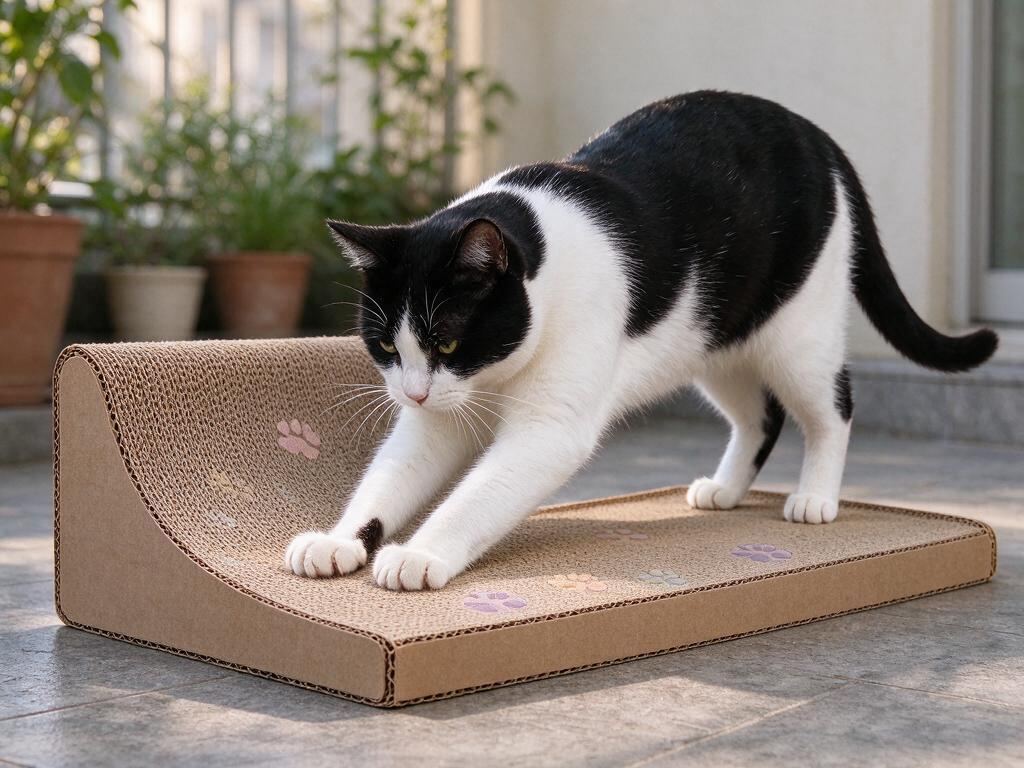
A slanted corrugated scratcher shows the surface that must match the production run, not just the bench sample.
The sample is the wrong thing to approve. Not because it’s dishonest, but because it’s built differently: usually one person at a bench, taking their time, using whatever board was within reach. The run is built at line speed by people who never saw your meeting. The question that matters isn’t whether the sample looks right, but whether it was built the way the run will be built.
Start with the board. Ask the cardboard cat house factory which flute the production run uses and which direction it runs. E-flute at about 1.5 mm is common here, and it prints and wears differently from heavier board. A sample built from heavier stock because that’s what sat on the shelf gives you a scratch surface that isn’t the one shipping.
Then do the pad math instead of glancing at it. A 10 cm pad stacks roughly twice the sheets of a 5 cm pad, so sheet count, weight, unit cost, and carton fill all move together. Trimming a pad is a fair way to hit a price point. Trimming below what an adult cat needs to stretch out buys a small saving and sells you returns.
Packing goes wrong when decisions land after the cartons are ordered. A retail box dimension that surfaces late can invalidate the carton size, the units per carton, and the freight estimate at once. Carton dimensions, units per carton, and barcode position get signed off before the print run, not after.
Two figures get misread the same way. The sample clock starts when structure and artwork are agreed, so a slow dieline decision pushes the whole schedule, not just the sample. A sea transit figure is port-to-port; customs clearance and the inland leg sit on top of it, which is what a landed-cost sheet needs.
Before the run starts, ask for one unit pulled off the production line rather than off the bench. If the supplier can’t produce one, only the sample has been proven — the run hasn’t.
Questions that separate a real cardboard cat house factory from a trading desk
A trading desk can forward a catalog, quote a unit price and book a sample. What it usually can’t do is tell you where the die physically sits, because it doesn’t own one.
| Ask (in writing) | Expected evidence | Red flag | Responsible party |
|---|---|---|---|
| Which steps run in-house — die-cutting, gluing, printing, packing — and which are subbed out? | Line photos or a short clip of those stations, plus a list of what goes out and who checks it | It only mentions “our partner factory” when you ask where the die lives | Sourcing lead |
| Was the sample run on the production line, same board and flute direction? | Dieline, flute type and direction, pad thickness, sample photo beside the bulk stack | A bench-built sample with a different liner, waved through as “the same thing” | Product design |
| What’s the MOQ for this exact spec and pack format? | A quote line stating MOQ against your drawing, not a catalog number | The figure moves between emails, or drops when you push back | Procurement |
| Which pack formats can the line run: retail color box, e-commerce sleeve, shipper? | Carton dimensions, units per carton, and a packed unit you can lift and turn | Carton cube shows up after the freight quote, or never | Channel owner |
| Which board grade goes in the shipper, and is there test data? | A named grade with burst or edge-crush results, or a straight answer on what they buy and why | No grade named, no data, no offer to get either | QC contact, not sales |
| If ISO 9001 is claimed, what’s the scope and what did the last internal audit flag? | Certificate scan with a number and scope wording, plus someone who can discuss findings | A logo on a slide deck and no number to check | QA or compliance |
Put a name and a due date against every row; a question copied to five colleagues is a question nobody answers. Get carton dimensions and units per carton before anyone quotes freight — a per-unit price with no cube doesn’t compare across suppliers, however tidy the spreadsheet looks. The ISO 9001 answer gets the same treatment as everything else: Petaful lists it among its process signals, and the follow-up is still what the scope wording covers and what the last internal audit turned up. A certificate name says nothing about who decides whether a batch with a weak glue line ships.
What to settle before you request the sample
Settle the route before you ask for a sample. Whether it is a stock program with a pack change, an OEM build to your drawing, or an ODM item off an existing mold changes what the sample is even testing. Once the route is fixed, the sample answers a narrower question: does it hold at the spec you named? Order one ahead of that and you get a unit that matches a quote resting on assumptions nobody wrote down.
Three things make a first inquiry answerable: target volume, the pack format your channel needs — retail box, e-commerce sleeve, or both — and the date the product has to be on shelf or live on the listing. Those answers separate a stock tier from a custom run, and they decide which route gets quoted at all. A sketch, a reference item, or a filled-in catalog form is enough to open a private-label conversation with a cardboard cat house factory. Nobody needs finished artwork for a first feasibility read.
Then hold the reply to five items: MOQ basis, tooling, sample clock, production window, and carton dimensions. That last one carries more weight than buyers expect — it sets how many units clear a pallet, a container, and a shelf bay, and it can flip the cheapest quote into the most expensive one. If any of the five is missing, the reply reads finished but the next email round starts from zero. That is the shape of a first inquiry Petaful can quote from: a drawing or a catalog form with volume, pack format, and date on it, answered with a number that carries its basis instead of a range.
Questions
What should a cardboard cat house factory quote state besides price?
It should name the route, the MOQ basis, tooling, the sample clock, the production window, and carton dimensions. A price without the pack format behind it is not comparable, since a poly-bag quote and a printed color box quote are different numbers.
Can a cardboard cat house factory quote without final artwork?
No finished artwork is needed for a first feasibility read. A drawing or a catalog form with volume, pack format, and target date gives a factory enough to respond; Petaful works from either and returns design drafts within about 3 days.
Does a 10 cm scratch pad cost more than a 5 cm pad?
Yes, and it moves more than the pad price. A 10 cm pad stacks roughly twice the corrugated sheets of a 5 cm pad, so weight, cost, and container fill shift before anything is printed; confirm the reorder keeps the same flute.
Should the approval unit come off the line or from the bench?
Pull one off the line. The unit shown in the meeting room was not built at line speed, so only a production unit shows what the scratch surface and the pack actually do; agree flute type and direction before bulk.

About the author
Petaful Editorial
Factory editor
Edits sourcing notes for pet brands and Amazon sellers, from the Petaful floor in Shenzhen.