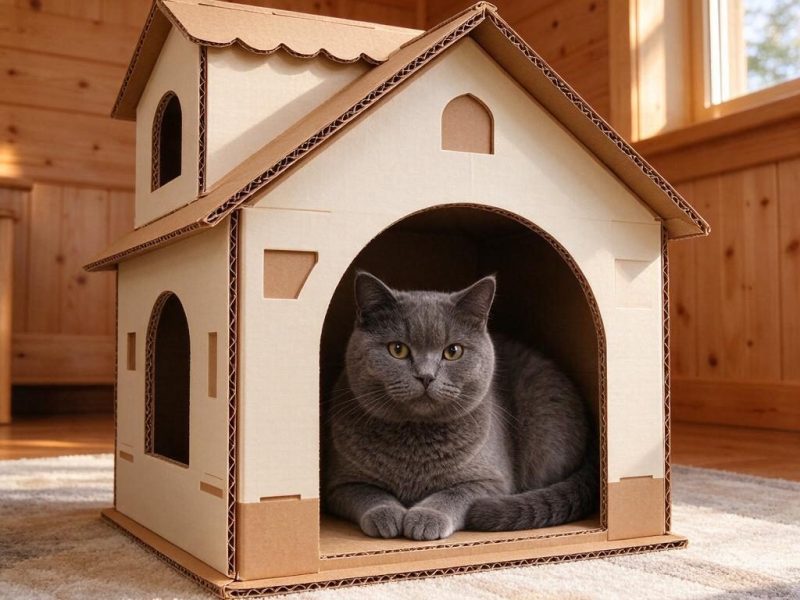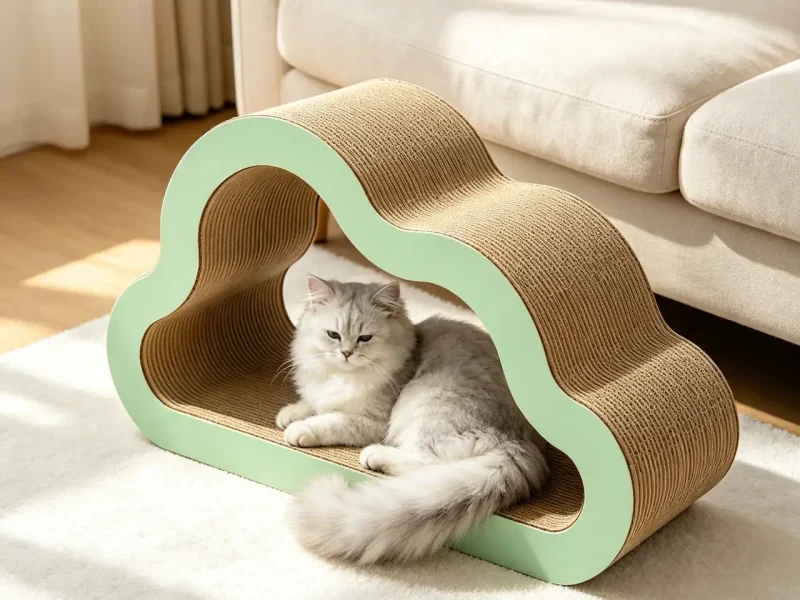

What changes when you order cardboard cat houses in bulk
The gap between a 50-piece quote and a 200-piece quote for cardboard cat houses is usually not a volume discount. It’s a different build. Somewhere in between, the job stops being a stock unit pulled off a shelf and becomes a print run with setup to pay for — or a print run that turns into a retail pack with tooling.
In practice, quotes cluster into three tiers. Stock units start around 50 pieces: an existing size and construction, no print setup. A printed color box run opens near 200, where the money moves into plates and a shelf-ready box. A retail or FBA-ready custom pack sits at 200 pieces plus tooling — die work, barcode and label position, a carton spec that survives a fulfillment center.
That’s why the per-unit number steps instead of sliding. Crossing a tier isn’t buying more of the same object; it’s buying a different object, and the cost drivers travel with it: board grade and flute, how much paper the size eats, die-cut complexity, printing and finish, the pack format, the quantity, how far the customization runs.
Cash timing is the other half of the decision, and unit price hides it. Tooling is paid once and stays with that design. Board, printing, and packing get paid on every run. A 200-piece first order with tooling can take more cash out of the account up front than a larger stock order with none — even at a lower unit price.
Before you put two numbers side by side, ask what each one covers: board grade and flute, plates or tooling, whether the pack format is included. Two quotes from different tiers can describe two different products. Read the contents first, the total second.
Stock, color box, or FBA-ready: what each cardboard cat house tier costs
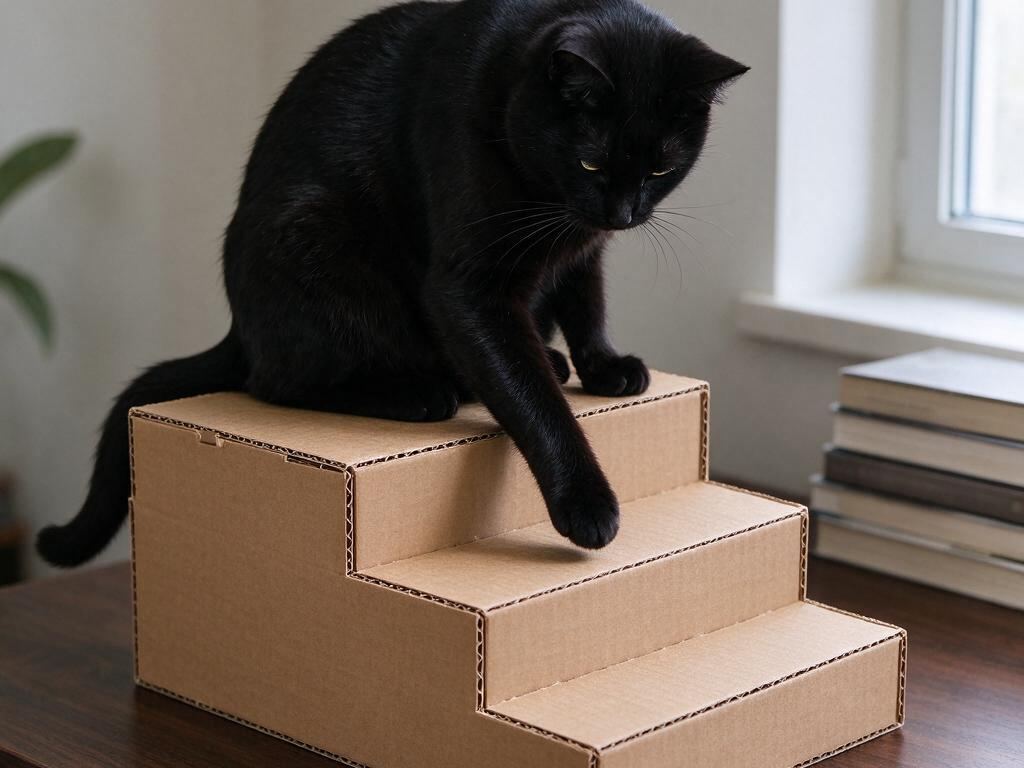
A stock-tier house comes off an existing die — plain board, no print setup.
The three tiers get quoted side by side, but the columns that decide the order are narrower than the pitch: MOQ, what sets off a tooling charge, and what the unit price actually contains. Packed dimensions stay off the sheet until someone asks.
| Tier | MOQ (pcs per design) | Tooling / setup | What the unit price covers | Packing format | Best fit |
|---|---|---|---|---|---|
| Stock | ~50 | None | Board, master carton | Flat or nested, master carton only | First SKU test |
| Printed color box | ~200 | Plates, one-off | Board, print, color box, master carton | Color box inside master carton | Seasonal shelf run |
| Retail / FBA-ready | ~200 plus tooling | Custom die, one-off | Board, full print, retail pack, master carton | Individually packed, barcode-ready | Marketplace listing |
Those piece counts describe how the tiers usually stack, not a published rate card, so verify them against the quote you’re holding. Then ask the two things the table can’t answer. Is MOQ counted per design or per purchase order? Does the tooling charge repeat on a reorder? A plate or die paid once spreads across every run after it. A charge that comes back with each order does not, and that line alone often decides which tier pays back first.
The middle tier is where the arithmetic surprises people. Pay the plate charge once, spread it over a few hundred units, and the per-unit cost lands closer to stock than the jump from stock to custom suggests. It stops being cheap the moment the design moves: an original structure, a multi-part build, or a laminated liner pulls in different board and different tooling, and the price follows the design rather than the tier. Printing one outer face and leaving the scratch panels bare is the usual compromise — color where the shopper looks, board where the cat digs in.
Retail and FBA-ready packs look expensive until the packaging is priced on its own. Color box, poly bag or mailer, barcode label, and an outer carton that holds up in a damp stockroom are separate line items when you source them yourself, on separate lead times. Ask for the same order quoted both ways — packed in-house and packed by the supplier — plus packed dimensions and carton weight for each tier. Operations can’t price freight without those numbers.
Which tier fits your situation, and what goes wrong on a first order
Start with the distributor holding one untested cardboard cat house and no read on whether it sells. That buyer wants the least cash tied up in a design nobody has bought yet, so the fit is a stock shape, or a small color-box run if the brand has to appear on shelf. Test the plan against the retail price you intend to charge: stock comes off a die that already exists, and nobody redraws a roof line to gain two centimeters. If those proportions make the price look thin, a stock run is the wrong answer however cheap the quote reads.
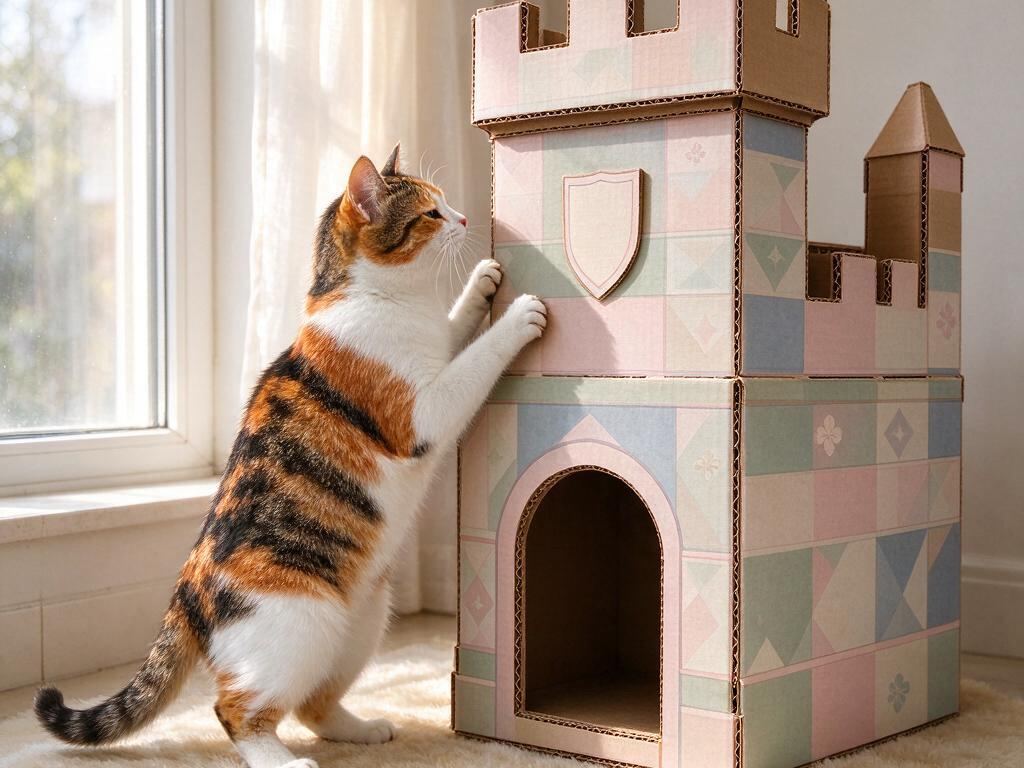
A printed seasonal run is a calendar buy: the pack earns the shelf, freight is set by carton dimensions.
A seasonal retail buy is a calendar business, and a printed color box is what earns the shelf. Freight is set by packed dimensions and units per carton, not by how the mockup looks, so pin both down before anyone agrees to a carton plan. A box that photographs well and cubes badly won’t pay for its print.
A marketplace seller needs a shelf-ready unit, which is a packing spec rather than a better-looking box. The unit has to come out of the mailer protected with its barcode still readable after inbound handling, so label placement and a master carton built for the fulfillment center get settled at packing. Retrofit either one after the first shipment and you are repacking stock you already paid to produce.
The sample is where most first orders go wrong. Approving one that was never packed in its retail form proves the die-cut folds; it does not prove the house survives its own packaging, or that it still looks sellable after one trip through a courier network. Ask for the sample printed, sealed and boxed the way production will ship it.
Flat-pack against assembled is the other gap. Two quotes that sit far apart often differ in packed volume and assembly hours rather than board cost: flat-pack ships denser and drops freight per unit, while assembled arrives shelf-ready and puts the labor back at the factory. Three questions cover most of that ground on a first order:
- Flat-pack or assembled — and if flat-pack, which parts arrive knocked down?
- Packed dimensions and units per master carton?
- Did the sample ship in its printed retail pack, sealed the way production will seal it?
What to ask before you approve a cardboard cat house sample
Two questions decide whether the rest is worth asking: is MOQ counted per design or per purchase order, and which change adds tooling — a new die, a new print, or a new pack? Get both answers on paper. A supplier who replies only in prose usually means the number was never documented.
- Spec sheet. Board grade and flute named on paper, plus packed dimensions. A grade that exists only in conversation isn’t a grade yet.
- What the sample proves. Fit of the die-cut once assembled, print registration on the finished surface, packed size. Not whether the flat unit survives its own shipping carton — that’s a separate test.
- Lead time, split. Production against transit. Published timelines commonly run 7 to 15 days in production, then 7 to 15 days by express or 25 to 35 days by sea, so plan around 6 to 8 weeks door to door.
- Die ownership. Who holds the tooling after the first order, and what that does to the reorder price.
Petaful lists ISO 9001, design drafts within 3 days, and an official sample usually ready 5 to 7 days after art is agreed, free for new customers. Ask the other suppliers for the same items in writing, then check them against the sample in your hands rather than the reply email.
Questions
Which trade terms do you ship on?
EXW, FOB, or DDP. Tell us the destination and which term you want, and the quote uses that term. Name it on export packing.
Should I start with OEM or ODM?
Start with OEM when you already have a drawing or a print-ready file. Start with ODM when you want an in-house mold and your artwork on it. A repeat of an approved piece is a reorder. The two paths are on OEM and ODM.
What does Petaful manufacture?
Corrugated cat scratchers, houses, posts, litter boxes, and toys. ZB-0192 is one pair of pads that stands as an L, a tunnel, or a step. Browse the product list.
How do you handle a quality claim?
Send the order reference, SKU, carton mark, photos, and delivery details. Petaful checks the reported issue against the signed sample and order record, then agrees a remedy for a confirmed manufacturing or packing fault. Write to sales.

About the author
Petaful Editorial
Factory editor
Edits sourcing notes for pet brands and Amazon sellers, from the Petaful floor in Shenzhen.